
The enigma of what lies beyond the final breath is perhaps the only universal preoccupation of the human race. Across every culture and era, we have constructed elaborate mythologies and theological frameworks to explain the transition from life to death: the scales of justice, the pearly gates, or the cycle of rebirth. Yet, despite centuries of philosophical debate, the true nature of the afterlife remains shielded behind an impenetrable veil—unless, like Brian Miller, you happen to step through it and return to tell the tale.
Brian Miller, a 41-year-old truck driver from Ohio, was a man accustomed to the tangible realities of the physical world. His life was defined by the weight of a steering wheel and the rhythmic hum of the interstate. However, in 2014, his reality shifted from the concrete to the celestial in a matter of seconds. While at home performing the mundane task of struggling with a stubborn container lid, he was suddenly leveled by a crushing, white-hot pressure in his chest. Recognizing the symptoms of a cardiovascular catastrophe, he managed to dial 911. “I’m a truck driver and I think I’m having a heart attack,” he told the dispatcher, his voice strained by the onset of a “widowmaker” event.
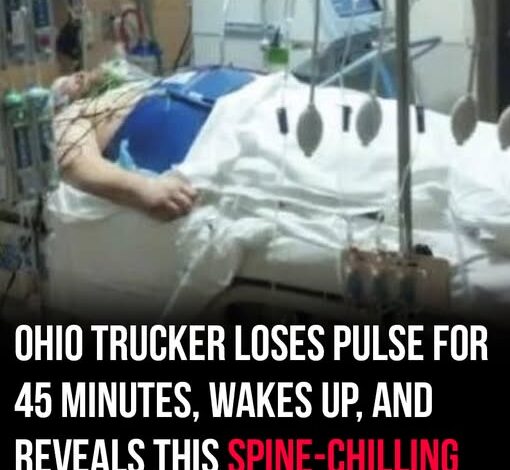
He was rushed to the emergency room, where medical staff worked with surgical precision to clear a total blockage in his main artery. For a brief moment, it appeared that Brian had escaped the scythe. But the human heart is a complex electrical system, and the trauma of the attack triggered a lethal malfunction: ventricular fibrillation. In this state, the heart ceases its productive beat and descends into a chaotic quiver, failing to circulate blood to the brain and vital organs. Brian Miller flatlined.
Emily Bishop, an ICU nurse who was present during the crisis, describes the scene as a clinical void. Brian had no heart rate, no blood pressure, and no palpable pulse. He was, by every medical metric available to the modern world, deceased. Doctors initiated the frantic choreography of “strong, hard, fast CPR,” breaking ribs in an attempt to manually pump life through his body. They administered four high-voltage shocks with a defibrillator, hoping to jump-start the heart’s internal rhythm. None of it worked. After nearly three-quarters of an hour of unsuccessful resuscitation efforts, the medical team faced the somber reality of the situation. Brian Miller was pronounced dead.
For forty-five minutes, Brian’s body sat in the absolute silence of clinical death. His brain was deprived of oxygen—a duration that typically results in irreversible cellular decay and permanent brain death. But while the room in Ohio was filled with the heavy atmosphere of loss, Brian says he was elsewhere.
He describes the transition not as a fading into darkness, but as an awakening into a vibrant, luminous landscape. “The only thing I remember,” Brian recalled, “is that I started seeing the light, and I started walking toward it.” He found himself on a path that defied earthly description, lined with flowers that possessed a saturation of color he had never seen in the physical world. It was there, in this celestial corridor, that he encountered his late stepmother.
The reunion was a far cry from the sorrow of a funeral. He described her as “the most beautiful thing” he had ever seen, appearing exactly as she had on the day they first met—vibrant, youthful, and radiating a profound sense of joy. She didn’t offer a philosophical lecture; instead, she reached out, took hold of his arm, and spoke with the authority of someone who knew the grand design. “It’s not your time,” she told him firmly. “You don’t need to be here. We’ve got to take you back; you’ve got things to go and do.”
Back in the hospital room, as the staff prepared for the grim administrative aftermath of a failed code, the impossible happened. Without the intervention of a needle or a shock, Brian’s pulse returned “out of nowhere.” It was a spontaneous resurrection that left the seasoned medical staff in a state of shock. Nurse Bishop noted that even in the rare cases where a heart restarts after such a long duration, the patient is almost always left in a persistent vegetative state. Yet, Brian didn’t just return; he returned whole. Within a short time, he was sitting up, laughing, and conversing with the very people who had watched his life slip away.
Brian’s story has since become a cornerstone for those researching near-death experiences (NDEs). While skeptics often point to the physiological effects of a dying brain—such as the release of DMT or the firing of neurons during hypoxia—as the source of such “visions,” Brian remains unshaken. For him, forty-five minutes of non-existence provided more clarity than forty-one years of life. He returned with a singular message for those still navigating the uncertainties of the mortal coil: “There is an afterlife, and people need to believe in it, big time.”
The impact of Brian’s experience transcends the medical anomaly of his survival. It touches on the fundamental human need for hope. For many who have lost loved ones, his description of a “happy, beautiful” reunion offers a sense of peace that no clinical data can provide. Brian Miller no longer fears the end of the road. He views his return not just as a medical miracle, but as a divine extension of his “logbook,” granted so he could share the news that the end of the line is actually the beginning of a much brighter journey.
Today, Brian continues his life in Ohio, but his perspective has been permanently recalibrated. He is a man who has stood on the threshold of the ultimate unknown and found that it wasn’t a void, but a destination. His story serves as a reminder that even when the monitors go silent and the pulse vanishes, there may be a path lined with flowers waiting just beyond the light, and perhaps, a familiar hand waiting to guide us home—or, if we’re lucky, to send us back.
I can provide a comparison of Brian’s account with other famous near-death experience case studies or help you explore the current medical theories regarding consciousness during clinical death.


